


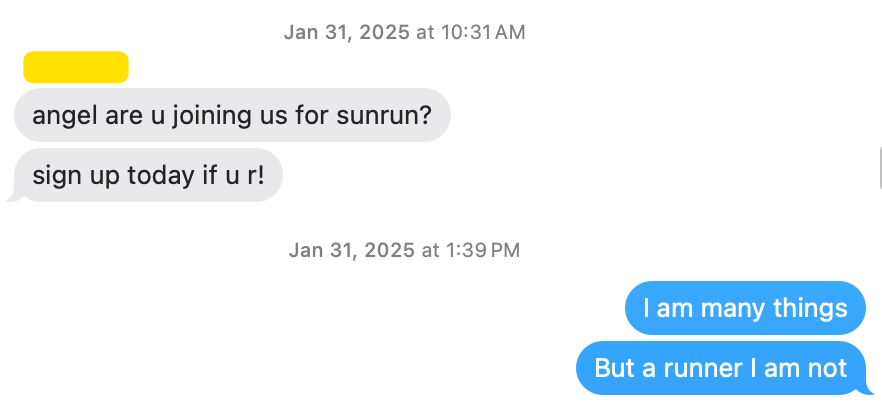
If you told me at the start of 2025 that I’d start running, I would have laughed in your face. In fact, my friends asked me to walk the Sun Run, a 10k race in Vancouver and I did laugh in their face. I’ve always hated running. We were required to run 1.2 kms at the start of every PE class in high school and I’d take the short cut every time or take the entire 13 minutes they gave us to do them. I could count the number of times I used the treadmill at my gym on one hand.
And yet, here I am. First week of January, running 3-4 times a week. Voluntarily. In the COLD (I think I hate the cold even more than running tbh). And the craziest part? I actually look forward to it.
I actually did my first run in March of 2025. I was going through a a period where I felt a strong itch to change something. Looking back, what I needed was to leave my relationship at the time but alas, my avoidant tendencies kicked in and I went with running instead.
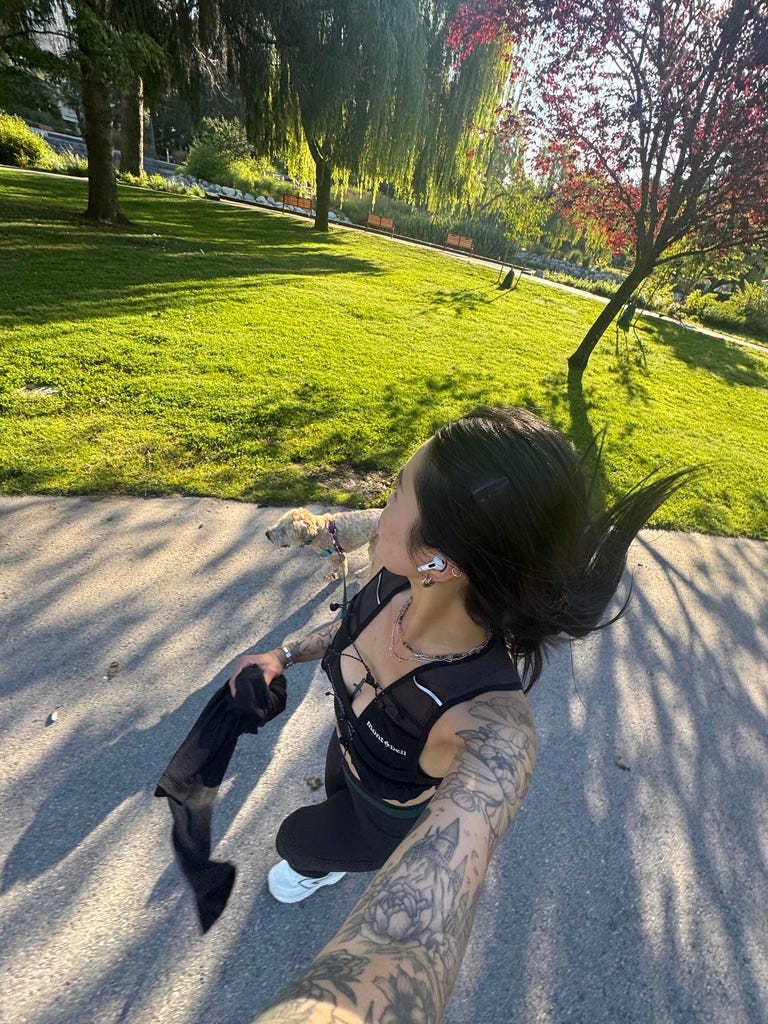
That first run felt like hell. I tried to follow a Nike Running Club Couch to 5K program and man, they do not mess around. I’m honestly still learning that runs aren’t meant to be hard—that if it feels hard, you’re pushing yourself too much. The aftermath was even worse. My hips, knees, calves, and feet felt like I’d been hit by a tornado and I could barely walk for the rest of the week.
I’m honestly surprised I didn’t give up at that point.
But looking back, I think I know why I didn’t. Life felt completely out of control at the time. Work was chaotic, my personal life was a mess, and I was carrying this low-grade anxiety that I couldn’t shake. Everything felt hard in a way I couldn’t do anything about. But running? Running was hard in a way I could control. It was something I could choose to do, choose to push through, choose to show up for.
I needed to prove to myself that I could do a hard thing without giving up. That I could push through discomfort when it actually mattered. I needed to feel like if I could do this, I could go back to being the person I wanted to be in other areas of my life too.
So I went to The Running Room, brought proper sneakers and ran again. Slower this time. With a plan and a little more grace for myself.
While I still can’t confidently call myself “a runner”, I don’t think you have to be to start running. I’m not training for a marathon, I’m not trying to hit a certain pace. I just want to be fitter, stronger, and more disciplined. I want to continue the journey I started last year and remind myself that I am the version of me I always knew I could be.
Here’s what I’ve learned so far—and what I wish someone had told me before I started.
It sounds cheesy but starting is truly the hardest part. Not because running itself is that difficult (though it will feel awful at first), but because we overthink it. We think we need to be in better shape before we start. We think we need expensive gear. We think we need to know what we’re doing.
But really? You just need to show up. Everything else, you figure out along the way.
So if you’re thinking about starting—if you’re curious but skeptical, or if you’ve tried before and it didn’t stick—here’s what actually helped me get invested into running.
Do a running program
Starting anything new can feel incredibly intimidating. There’s so much running content out there but they’re usually people who are training for a marathon or clearly have already been running for years. While it’s super motivating seeing humans do these incredible feats, it does not always spark confidence in a beginner.
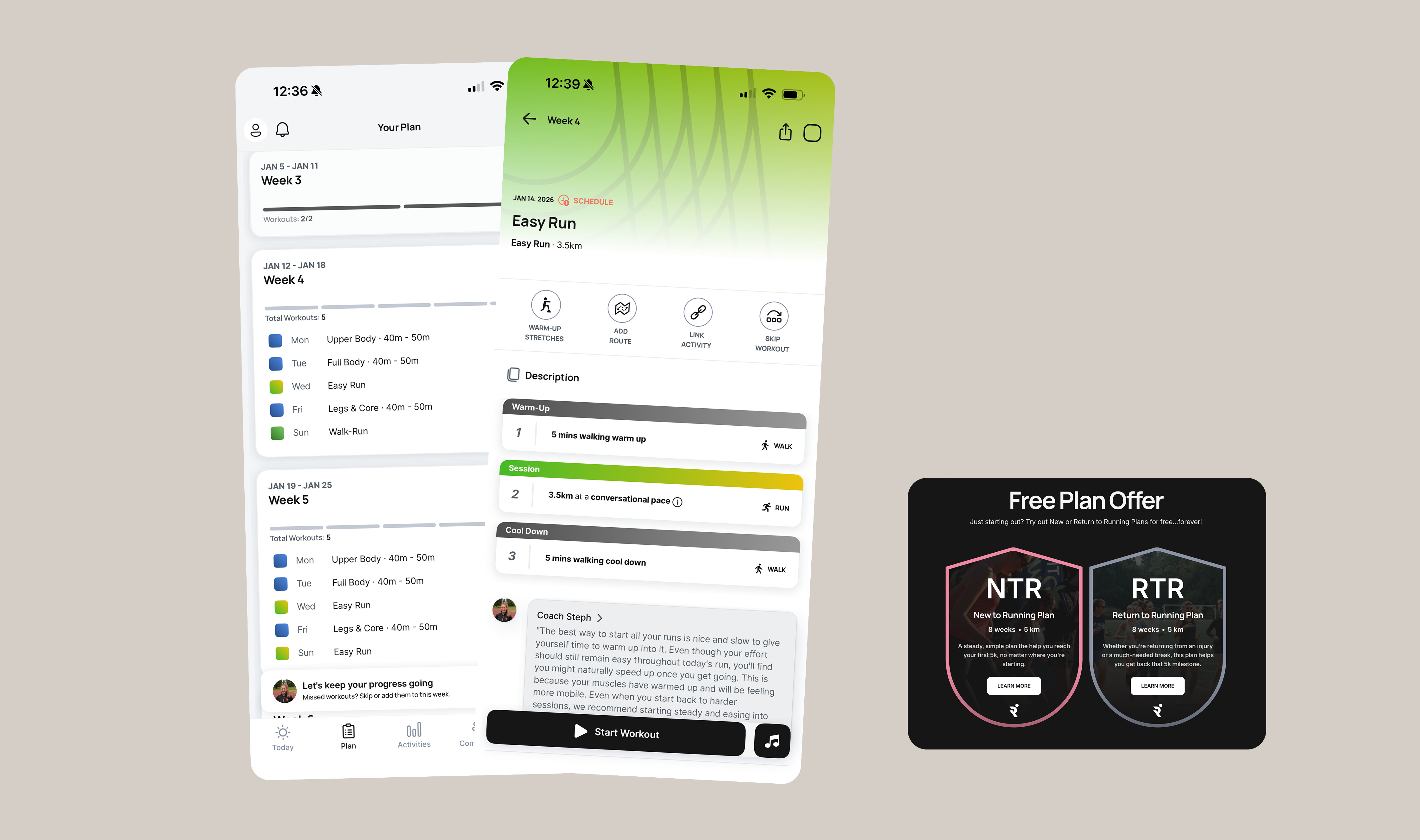
I started with the Nike Run Club app but then actually switched over to using Runna. The first NRC run felt pretty difficult but I did like that their coaching includes someone talking into your ear and actually explaining how the run should be feeling and what you should be paying attention to. I honestly don’t really have a preference between the two but I personally stuck with Runna after starting it.
The NRC app is completely free I believe while Runna offers you two running plans for free (New to Running and Return to Running) which are both 8 week programs that help you run a 5K.
The short walk-runs in Runna might feel boring at first but I am learning that by building my aerobic fitness slowly, it’ll help make the longer runs feel easier. I’m really am still just building my endurance and stamina muscle and that’s perfectly okay to me. Runna also gives you the option to add strength training days to your plan as well so if you’re wanting both weight training and running guidance, it’s a great option.
Buy the gear (you actually need)
I’m absolutely guilty of looking up every piece of cute running gear I see online only to be shocked at how much a thin windbreaker can cost and then closing all my browser windows so I don’t accidentally bankrupt myself. While I’m a firm believer that having cute gear does actually act as a motivator for any sport, I do also understand that I’m a woman of many hobbies and cannot actually afford to buy everything that’s on my wish list.
However, it is true that having the right gear can sometimes make or break your experience with an athletic endeavor. I don’t have perfect feet and have bad knees to start so running in my gym shoes quite literally felt like the worst decision I’ve ever made.
Non-negotiables
Running shoes
When buying running shoes I’d HIGHLY recommend going to a running store and asking the staff to explain everything to you. I tried on all the shoes that I see on everyone’s feeds and ended up getting a New Balance pair that I’ve never heard of before. What works for one person’s feet, stance, posture, and running style isn’t necessarily going to work for you. Some running stores will actually have promotions where you can buy the shoe, run in them, and if they suck, return them so PLEASE do yourself a favor and shop in-person if you can.
Honestly thought this was a gimick until I ran in a random pair of socks one day and it gave me blisters on both feet. While not all of my socks do that, having any cushioning in the wrong place will rub the wrong way as you run. So while I still do wear some of my crew socks for running, I do think running socks are well worth the investment.
Arm band or running belt
I get SO overstimulated with my keys and phone bouncing up and down inside of my pocket so I got a running belt pretty early on. I actually did end up buying a running vest as well while I was in Japan at Montbell which I also love but for all intents and purposes, the running belt does just as well.
A lot of people talk about the SPI belt on runningtok but places like Lululemon make them as well.
Nice-to-haves
Fitness watch
I already owned an Apple Watch so I used it to track my runs. Both Strava (running tracking app) and Runna allow you to track your runs just with your phone by using the GPS in your phone to calculate distance. Having a fitness watch does give you some extra stats on your heart rate and how you’re doing but it’s definitely not essential when you’re starting.
As someone who mainly runs around a park or on sidewalks, these are by-far my favorite ear buds. If you haven’t heard of them before, instead of sitting in your ear, these actually act as ear cuffs meaning it gives you great sound quality while still allowing you to completely hear what’s going on around you. They also stay on quite well so you don’t have to be worried about losing one during your run.
What’s the deal with Strava?
If you’ve spent any time around runners (or runner Instagram), you’ve probably heard of Strava. It’s basically a social media app for tracking workouts—mostly running and cycling. You log your runs, it shows you stats like pace and distance, and you can follow friends and see what they’re up to.
When I first started running, I avoided Strava because it felt intimidating. Everyone seemed to be running faster and farther than me, and I didn’t want to broadcast my slow, short runs to the world. But eventually, I caved and downloaded it, and honestly? It’s been one of the most motivating parts of my running journey.
Here’s what I actually like about it:
It tracks your progress automatically. If you have your phone or watch with you, Strava uses GPS to map your route and calculate your distance, pace, and elevation. It’s satisfying to look back and see how far you’ve come—literally.
The community aspect is surprisingly motivating. When people “kudos” (like) your runs, it feels good. It’s a little hit of encouragement that makes you want to show up again. I’ve also found it helpful to follow other beginner runners—it normalizes the fact that not everyone is running 10-minute miles.
You can keep it private. If you’re not ready to share your runs publicly, you can set your activities to “only me” or “followers only.” I kept mine private for the first month until I felt more confident.
It gamifies running in a way that works for me. Strava has challenges (like “run 50km this month”) and achievements (like “fastest 5k” or “longest run”). They’re completely optional, but they give me something to work toward without the pressure of an actual race.
My take: If you’re curious, download it. Track a few runs privately and see how it feels. If it motivates you, great. If it stresses you out, delete it. There’s no rule that says you have to use it to be a “real runner.”
Practical tips that actually helped
Okay, now for the stuff I wish someone had told me before I started. These aren’t revolutionary, but they made a huge difference in whether I showed up or gave up.
Mindset shifts
You don’t have to run fast (or far). Seriously. My first “runs” were 2 minutes of jogging followed by 3 minutes of walking, repeated for 20 minutes total. That counts. Slow running is still running.
Walking breaks are not cheating. Run/walk intervals are a legitimate training method. Some of my best runs include walking breaks. Your body doesn’t care if you’re fast or long—it just knows you’re moving.
Consistency beats intensity every time. Three easy 20-minute runs per week will do more for you than one brutal 5k that leaves you too sore to move. Show up regularly, even when it’s not perfect.
It’s okay to hate it at first. I hated running for the first month. It felt hard and awkward and boring. But I kept showing up, and eventually, something clicked. Give it time.
You’re not “bad at running”—you’re just new. Everyone starts somewhere. The people running marathons now were once gasping for air after 60 seconds of jogging. You’re building something. Be patient with yourself.
Actual running tips
Start slower than you think you need to. This is the advice I’m not really starting to understand. Your first runs should feel almost embarrassingly easy. If you can’t hold a conversation while running, you’re going too fast.
The “conversational pace” rule is real. You should be able to talk in full sentences while running. If you can’t, slow down. This is how you build endurance without destroying your body.
Run 3-4 times a week, max. As a beginner, your body needs time to adapt. More isn’t always better. I run 3-4 times a week and that’s it.
Rest days are not optional. They’re when your body actually gets stronger. I learned this the hard way after my first run left me unable to walk for a week. Rest is part of training.
Listen to your body (actually listen). There’s a difference between “this is uncomfortable” and “this is injury.” Uncomfortable is normal. Sharp pain, pain that doesn’t go away, pain that changes how you move? Stop. Don’t push through it.
Making it enjoyable
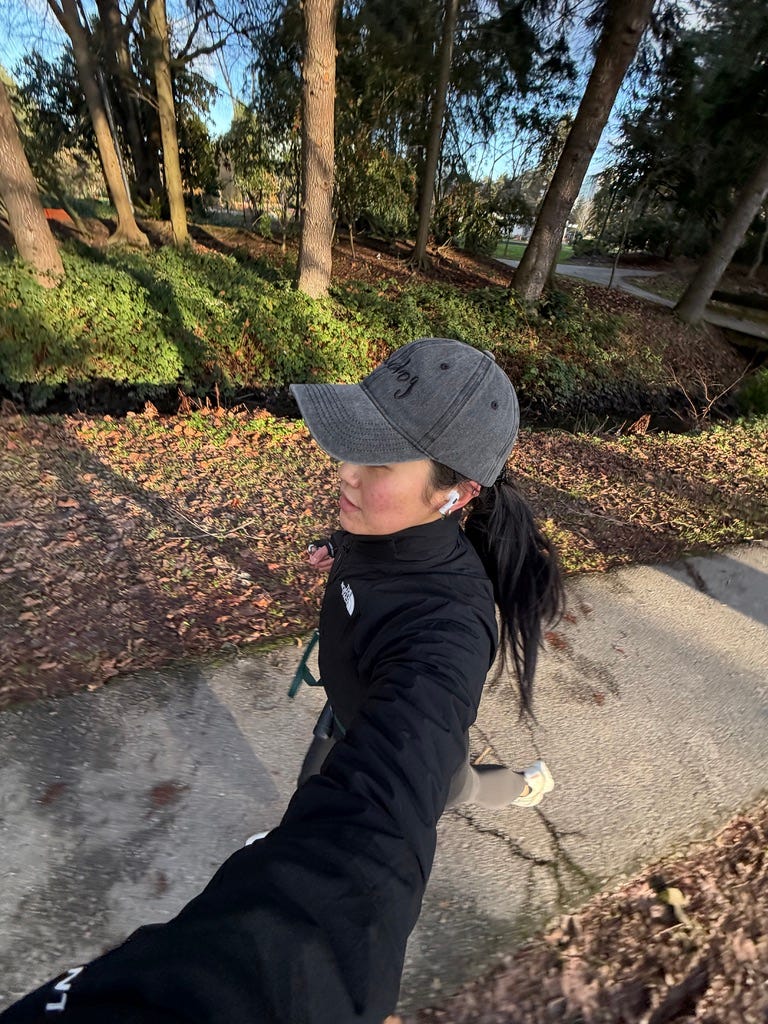
Find routes you actually like. I run around a park near my house because it’s flat, scenic, and I don’t have to think about where I’m going. Some people love trail running. Some prefer city streets. Experiment until you find what feels good.
Music, podcasts, or silence—whatever works. I’ve tried all three and honestly, it depends on the day. Sometimes I want music to pump me up. Sometimes I want a podcast to distract me. Sometimes I just want to hear my own thoughts (or lack thereof).
Run at the time of day that feels best. I love early morning runs before the city wakes up. My friend loves evening runs to decompress from work. There’s no “right” time—just what works for you.
Give yourself permission to stop. Some days, running just doesn’t feel good. Maybe you’re tired, maybe you’re stressed, maybe your body needs rest. It’s okay to cut a run short or skip it entirely. One missed run won’t ruin your progress.
Celebrate small wins. Ran 2 minutes longer than last time? Went an extra block? Didn’t walk as much? That’s progress. Acknowledge it. I keep a running journal where I write down little victories, and it’s incredibly motivating to look back on.
I’m still very much a beginner. I’m not fast. I’m not training for anything specific. But I’m consistent, and that’s what matters.
My goals for 2026 are simple: keep showing up 3-4 times a week, build up to running 5k without stopping, and maybe—just maybe—actually make my way up to running 10K (without feeling like I’m dying).
Running has become one of those rare things that’s just for me. Not for content, not for productivity, not to prove anything to anyone else. Just because it makes me feel capable and calm and like myself again.
If you’re thinking about starting, use this as your sign! Because I swear if I can do it, anyone can. You don’t have to love it right away. You don’t have to be good at it. You just have to try.
And who knows? Maybe in a few months, you’ll be the person you never thought you’d be too.
This was me six years ago! I couldn’t run at all but started with a goal of 5k (which I’d failed at before). And I think you’re right, the reason why I did make it that time round was because a) I had my people supporting me who were more experienced runners. They were super supportive and non-judgemental of my snail pace! And b) I really wanted to prove it to myself.
Fast forward to now, I’ve run two marathons and lots of half marathons. Because if I could do 5k…I could push to a 10k, right? And so on 😂
Still slow, but proud of the progress!
This was very timely thank you for all the detail. I'm comfortable with a 5k but nothing more and I'm working up to a 10k this year.. This is what I needed to read!